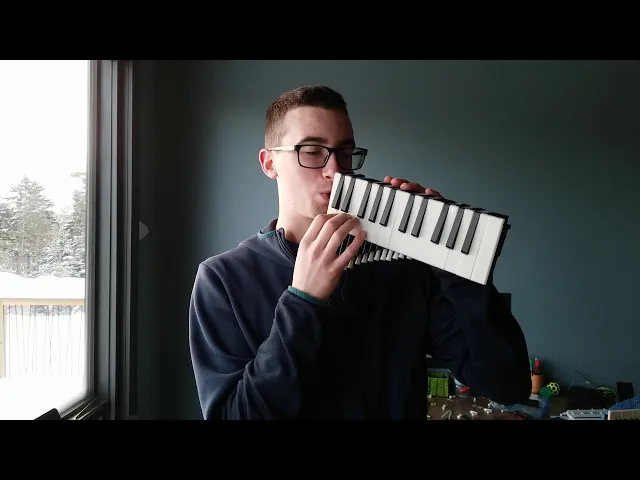

Ice Keys
Design
•
Engineering
•
Music
•
3D Printing
16
, 2018
–
Present
On my 17th birthday, my parents gave me a melodica. I had been wanting to have some kind of portable keyboard-based instrument lately, and the melodica is exactly that.
However, I was never all that pleased with the sound of the melodica. It's a free-reed sound somewhere between a harmonica and an accordion. It does a good job of being loud, but it can be harsh. The softer you try to play, the more difficult the playing becomes. So I wondered: was there a way to make a similar acoustic instrument, but with a softer sound?
That question led me to the idea of Ice Keys: an acoustic keyboard that sounds like polyphonic pan pipes. This article documents my design process.
Ice Keys P1
Before getting into the project, a small aside for naming: I chose to name the major versions of this project with P for prototype, because I may eventually decide that a version is final — at that point, I'll use V for release versions.
P1 was the very first version of this project, so I was starting from nothing. As such, I began with research and proofs of concept.
Proof of Concept
To start, I had two main goals to guide my idea:
I wanted the instrument to generate sound in the same way that most wind instruments generate sound: by blowing a jet of air over an opening at the end of a pipe.
I wanted to 3D print as much of the instrument as possible.
The first thing I modeled was a single whistle, just to see if I could get 3D printed parts to make sound that way. I was pleasantly surprised by how the first print worked (pictured below), and that gave me the confidence to go ahead with the rest of the project.

The first test whistle I printed for the Ice Keys project.
This first prototype had 25 keys, a 3-tone color palette and exposed mechanisms, giving it a steampunk feel.

Ice Keys P1.
Main Issues:
Pipe sealing. The pipes don’t seal well enough with the blocks that hold them, so the sound is at best a whisper.
Heavy key action. The keys are hard to press.
Bad ergonomics. It’s hard to hold (since it has no handle) and hard to play (since it has stiff, narrow keys).
Incorrect pipe lengths. The model I used to determine the lengths is based on too many idealizations.
Looks. The blue color is too pale and the off-white keys look dirty.
Ice Keys P2
The first playable version, also with 25 keys. Minimal casing and a better 2-tone PLA palette make for a sleek, versatile second prototype.
Main issues:
Valve Sealing. Some valves stopped closing after time in storage, making some notes sound all the time, whether the keys were pressed or not.
Tuning. The pitch varies significantly with variations in lung pressure, so tuning requires a steadier source of air, e.g. from a bellows.
Build Quality. While its appearance and ergonomics are much better than P1, P2 still feels like a prototype. Some edges are unfinished; some mechanisms uncovered.
Ice Keys P3
This is the most recent printed prototype. With its larger 30-key range, wrap-around case and compact action, it improves on P2 in many areas. This version has a 3-tone color palette, sporting a translucent royal blue and clear keys on a black body.
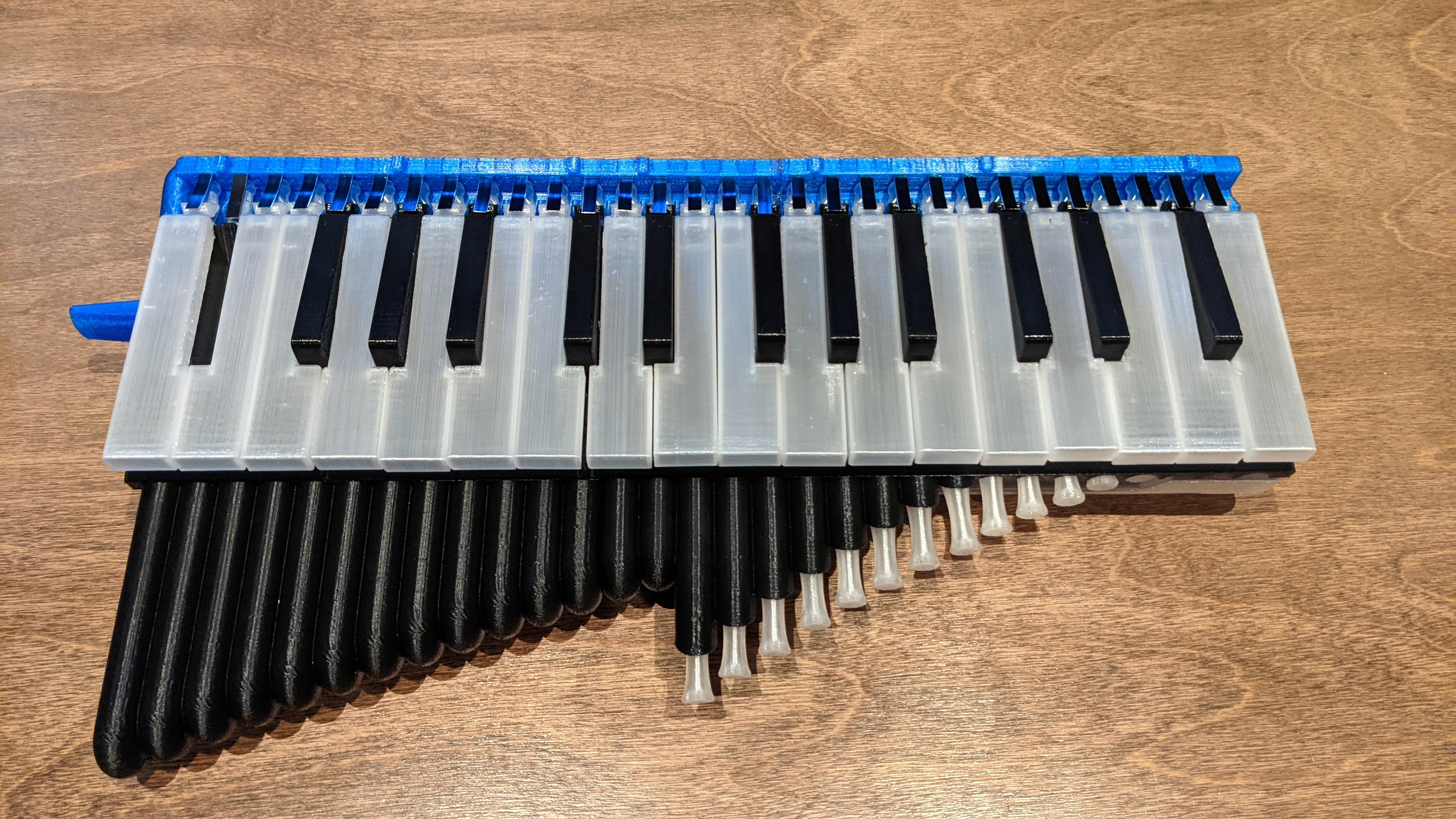
Main issues:
Pipe sealing. The switch to PETG filament made bubbles and tiny pores more common, which surprised me because PETG has exceptional layer adhesion. In addition, I added a 180° bend to the lower pipes. That curved roof has a large porosity as well.
The solution here was the obvious one: revert to PLA, which gives much better self-sealing results.
Anticipated: Tuning. This iteration will also need a steady air source for tuning.
Unexpectedly, this was not nearly as much of an issue for P3 as it was for P2. The new mouth design and lower overall range really helped.
Valves (again). Some valves stopped closing after time in storage, making some notes sound whether played or not.

